


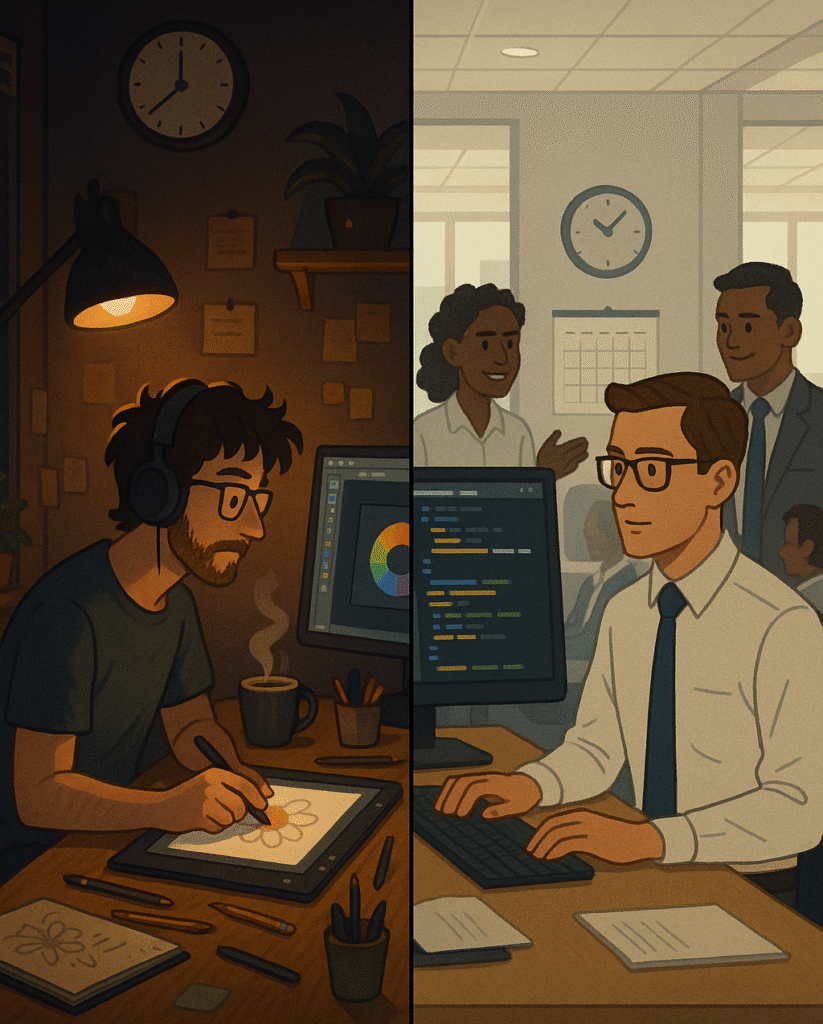
Some employees find themselves grappling with a final choice: pursue the freedom of freelancing or the stability of full-time employment. Having experienced life on both sides, I’ve come to realize that neither is inherently superior. What is “best” is purely dependent on your personal circumstances and nature.
This piece brings real-life situations into view to offer you a practical insight into the age-old debate. This way, you will get to evaluate these experiences and see what works better for you.
The Freedom Fighter: Why Some Thrive in Freelance
Sophia is a graphic designer. She spent years suffocating under a 9-to-5 job at a marketing firm. While she had secure pay and benefits, she wanted freedom and control over her work. Two years into freelancing, she hasn’t looked back.
“As a night owl,” Sophia says, “my corporate job needed me to work even when I don’t feel creative or inspired. Now I can design at 11 PM when inspiration strikes.”
Freelancing offers distinct advantages:
- Autonomy: You get to choose your clients. You can even choose projects and schedules.
- Location independence: You can work from anywhere in the world. All you need is good internet and a device that meets the minimum requirements for the gig you’re working on.
- Income potential: Most freelancers get to enjoy projects that can pay up to a year’s worth of salary for a 9 – 5 worker.
- Work-life integration: Unlike in a typical corporate job, you don’t need to take any leave. When you have an event, pick up your laptop and router and get on the go.
Freelancing is great, but it has its downsides. Sophia mentioned, “The feast-or-famine cycle is real, some months I double my old salary. Some months are real, I struggle to make ends meet. You need financial discipline and emotional resilience.” “
The Structure Seeker: The Case for Full-time Employment
Marcus took an opposite path and settled for a full-time web development job. He was a freelancer but left for less pay and admits that it is about the security and career development, and not the income.
“Freelancing was great on paper,” Marcus says. “But I spent more time chasing payments and finding clients than coding, which is my love.” He believes that most freelancers lose their true passions and work on what pays better. He also adds that working a full-time job builds discipline and time management.
From Marcus’ story, here are some advantages of full-time jobs:
- Stability: Unlike freelancers who don’t have a stable salary structure, full-time jobs offer predictable income. You can easily calculate your earnings by the hours of work you have put in.
- Benefits package: You enjoy health insurance, retirement plans and other benefits that add value to your employment. Most companies offer paid leave as well.
- Professional development: You can learn from a wide range of experts and boost your skills and career.
- Built-in community: The collaborative aspects of a workplace beat the solitude of working alone for most people.
“I missed the silent work in the night and all that,” Marcus says. “Now I have colleagues to bounce ideas off of and learn from. That social aspect was something I didn’t know I needed until it wasn’t there.”
Finding Your Perfect Fit
Most people view these as a binary choice where you can only choose one option. Before you jump to any conclusion, ask yourself these important questions:
1. How important is predictability when it comes to income? If you have high fixed expenses like a mortgage, the predictability of a salary will reduce stress. If you have savings or a spouse with a constant income, you can probably get by on the irregular income of freelance work. So typically, your needs and wants and their urgency should determine your choice.
2. How proficient are you in business administration? Freelancing will require you to wear the big shoes of marketing, accounting, project management, and negotiation. You’ll have to learn these or budget for contract work if you’re not proficient with business administration.
3. What stage is your career at? Look at where you are with your career and your ability to bounce back. If you are starting out your career, it is good to try a full-time job first to pick up important lessons. If you are already an intermediate who is confident in their skills, you can start with small freelancing gigs to learn the ropes.
The Hybrid Approach
The top professionals in the world blend the two and make the best out of them. Combining elements from full-time jobs and freelancing gives birth to the hybrid approach.
Jamie explains how this works: “I work 30 hours a week for a startup remotely with benefits, but I also have time for my own clients. It is a good combination of security and freedom at the same time.”
Common hybrid arrangements include:
- Maintaining full-time employment while developing a side hustle
- Combining part-time employment with freelance work
- Remote full-time positions that offer location flexibility
- Contract-to-hire arrangements to test potential employers
When to Consider a Change

As you grow in your career, there are things you must consider. Your priorities change with time, and you should re-evaluate when:
- Your financial situation changes significantly
- You experience burnout with your current work plan
- Your industry undergoes disruption
- Your personal circumstances change (relocation, health issues, family needs)
Many professionals move between freelance and full-time multiple times throughout their careers, taking valuable lessons from each experience.
The Bottom Line
The full-time vs. freelance discussion isn’t one of finding the absolutely superior choice—it’s about genuinely considering your needs and circumstances to determine which arrangement will allow you to thrive currently in your life.
It doesnt matter if you are drawn to stability or independence, the secret is alignment between your work arrangement and your authentic self. We work too many hours to settle for an arrangement that contradicts our natural tendencies and desires.
After all is said and done, whichever route you wish to take, CherryPay is always your trusted friend. We provide USD/EUR/GBP bank details that you can use to get payment quickly from your client and change to Naira in your local bank account. Our rates are very friendly and one of the best in the industry. You can install our app from your device’ App Store to begin the registration process.
